
News by: Jennifer Castenson, Real Estate Contributor for Forbes
It’s an exciting time for housing investment. Many times, catalyzing change requires hitting the bottom first and housing is very close to hitting the bottom of productivity, efficiency, ineffective regulation, and it also faces quickly escalating cost inputs.
If not actually hitting bottom, housing still faces these significant headwinds. Fortunately, innovation is knocking at the door to help the housing industry adapt and survive, but that also faces challenges. Innovation is not embraced as readily in housing as in other industries, but investment in data, collaboration and discovery is gaining traction.
Investment Redraws The Housing Process
As a serial entrepreneur focused on housing, Shanna Tellerman understands what it takes to be successful in the space. She also understands the demands on production homebuilding, such as adhering to national standards, diversifying for regional and division variation, creating design options and associated workflows, and sorting product catalogs with years of revisions in CAD. Today, that’s all manual work that is tedious and repetitive.
Shooting to solve for that time suck, Tellerman launched Geom, a platform that automates the repetitive tasks using available resources that keep the user’s standards and processes in place, but that can add a higher level of efficiency and fidelity.
“We create a set of drawings and do twin designs by using a plug in and creating the DWG files and AutoCAD options that are 50 to 100 pages usually so it’s complex,” Tellerman said. “We’re saving six weeks of a designer’s time. We can automate mirroring of the 40 to 50 sheets that need to be mirrored, and include a quality check, plus adopt to codes that are market specific.”
That’s not the only way that the design process is being expedited with new technology.
Matt Hollis is the general manager at custom home builder Lexar Homes.
“We’re saving more than a month in time by automating the process of design to have a faster permitting process,” he said. “We can adapt to change and regenerate information so that change variance and change management is under control.”
Creating those efficiencies takes a digital process that translates the home into a data set, which for decades the drawing has been very disjointed from the details that go into the drawing. Where it was happening was still difficult, partially because it wasn’t adopted by the industry at a large scale, making it less effective.
Data Investment: Digitizing the Home Process
Many new platforms are automating the digitization of the homebuilding process.
Michael Bergin is the co-founder and chief R&D officer at Higharc, a company that can convert home plans into shoppable 3D visuals, that also includes related estimating data and permit-ready construction documents.
Higharc’s approach streamlines the supply chain, making updates to plans across the board with a defined business logic.
“It looks at what SKUs building materials distributors have in what locations and what can be used in estimating, in such and such location, which can be defined once and executed on many plans at once,” Bergin said.
The technology is offering big efficiencies and improving accuracy. The dealers and distributors in the process very often receive drawings from builders that need to be turned into a quote. Higharc is able to recreate the drawings in 3D, mapped to the dealer’s business logic.
This is disrupting the long-time inefficient practice of passing a drawing from stakeholder to stakeholder who redoes the work instead of sharing it from just one digital platform and one data set. Technology like this is a strong investment target as it supports collaboration in a very fragmented industry.
But, investments aren’t always easy to come by.
Housing Innovation Missing Investment
Being a startup in an industry with large production builders and distributors is hard. Entrenched attitudes and a high aversion to risk add up to very slow adoption.
“Our preference is not to make an investment,” said David Beznos, the senior vice president of growth and strategic partnerships at one of the country’s largest homebuilders, PulteGroup. “We like commercialization where we don’t have to deploy capital.”
When startups don’t have a strong corporate financial investment, it’s hard for them to allocate resources adequately and to be able to drive any scale for sustainable growth. And, these startups represent the future of housing and the new processes it needs to adopt to improve.
New policy, like the ROAD to Housing Act, are working to support the difficult adoption of innovation. The Act is working to advance offsite construction, a process that has had a lot of appeal and little traction for decades, which may be due to the type of investment.
“In a lot of cases, it isn’t the right kind of capital,” Beznos said. “Homebuilders are slow. Venture capital tends to have rapid growth expectations and it’s not always realistic for the ramps for industrialized construction companies.”
In other cases, it’s unit economics.
“Costs matter,” he added. “It matters to us in every capacity. How we get to size, scale and efficiency is because we have a play book and we run the plays very well. We could do a better job of carving out time to try new and different. We, like any business, can improve customer experience and reduce cost, make it faster, better. It’s worthwhile, but it’s hard to do when you have the tyranny of the every day.”
In some cases, just opening the door and working with a startup can prove successful. Building out a way to test and pilot an innovative product or service is important for the growth of the homebuilder and the startup. In addition, being able to start small and add on slowly suits the low risk profile of a builder.
Beznos added that there is collaboration across the big builders that find value in spreading out and sharing the risk.
“Getting in the same fund will elevate the innovation,” he said. “There is an industry of relationship and collaboration where we can mitigate risk and ask another builder to take on a portion of it. It is an industry with connectivity – not a Pepsi versus Coke.”
Some builders are moving into innovation on their own.
Builder’s Investment Captures Housing’s Issues
Rohan Kulkarni, is the CEO at Canadian homebuilding company Rohe Homes. As the company’s founder, he invested in solving for the very glaring issues of high costs, slow construction, and outdated methods that make housing inaccessible to people who need it most.
Teaming up with co-founder Salik Khan, who had experience and expertise working with governments, Rohe Homes set out to build better, faster, higher quality and at a broader scale.
The approach is standardized by using robotics informed by advanced data sets. This process lowers risk by cutting time in half and offering a better cost control to builders.
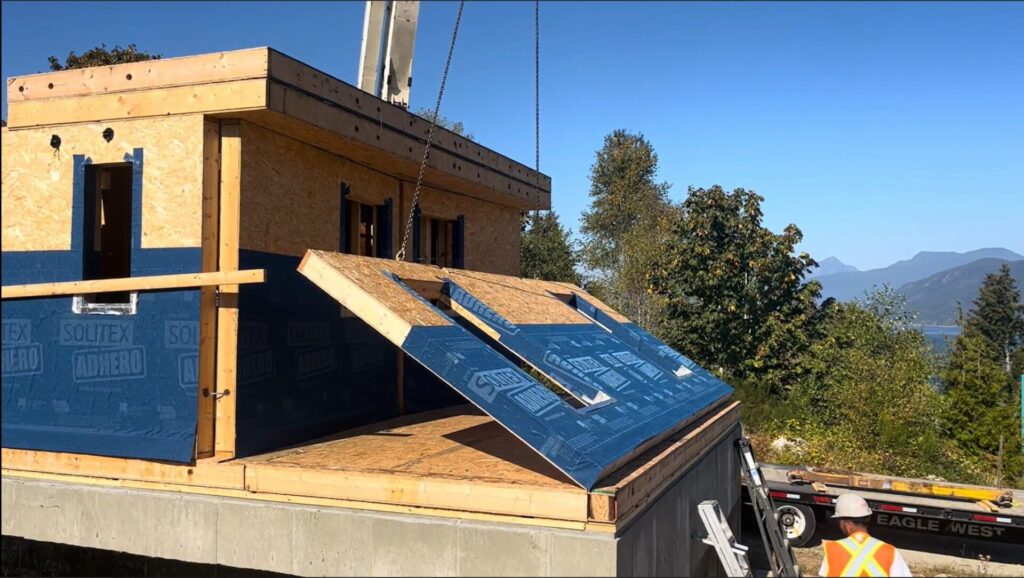
Rohe developed a proprietary foldable building system that solves last mile challenges by reducing transportation costs. It also delivers a highly efficient home that can be installed in just days.
Another way that Rohe is leveraging data is with an online platform that allows a builder to manage the process and track it. The platform also helps offsite construction overcome one of its many challenges.
“It solves for bank financing by offering pictures from the site and from the factory,” Kulkarni said. “Banks can then see the asset and the progress of the asset, along with a transparency payment tracker to show where money is going.”
That transparency extends to all project stakeholders. The architect, builder, financier, manufacturers and inspectors all have access to the platform and can take on their role in the process in a truly transparent way.
The platform gives true on-demand visibility to the two separate scopes of work, both onsite and offsite, which has been a barrier because of the differences with the with the more complex fee schedule.
Another startup was founded by a homebuilder who understood the need for better technology and the right data. Brian McCarthy is the co-owner of Abrazo Homes, and launched RIoT Technology because as a builder he recognized the need to improve homeowner insights to create a better homeowner experience, and to improve the builder’s profits.
Promoting this to all builders, McCarthy understands how insights from the technology could have far reaching implications for the future of home design and operations. When builders use RIoT they can start seeing homeowner activity and using that for better informed home design, product selection and performance.
A collaborative data set would inform a housing industry thirsty for knowledge, especially in the case of a new housing asset class that doesn’t have decades of consumer feedback.
Technology Investment Builds A New Asset Class
Housing is housing is housing…except when it’s not.
Bryan Smith is CEO and trustee at AMH Homes that manages 60,000 single family built to rent homes. Smith started when single family rental was not an asset class and he took a role in building it out with the right technology and the right partnerships.
“The only way to do that was with technology,” Smith said. “How do you build scale and then renovate. On the acquisition side, we built an internal app to scale. Then, we scaled with a partnership with The Home Depot for renovation. We were buying 400 to 500 homes per month, but we couldn’t lease more than 50. We solved it by creating a digital leasing agent so prospects could tour, apply and get a lease faster than they could otherwise.”
The company took leaps and challenged themselves to build technology that would take the sales team from a tour to a signed lease in less than an hour.
AMH continues to rely on data, and is now directing research to find insights on what residents need and want to help deliver a maintenance free lifestyle.
“We did survey work on what was really important to residents, and the answers were not intuitive,” Smith added. “We are getting 100,000 inbound inquiries per month and using data to drive those models.”
Others are leveraging data to put the homeowner in control.
The Customer Experience As Core Investment

For decades, Martha Stewart has been an icon for housing, and for years she has realized that there should be a technology investment in the homeowner experience. Years ago, she took ideas to Bill Gates at Microsoft who said it wasn’t time, but she was determined.
“A home is someone’s most expensive investment and now is the time,” Stewart said as founder of Hint, a home intelligence app.
Brian Kelly, also known as The Points Guy, is an investor in Hint. He says, “Buying a home is hard, but taking care of a home is harder. When I get a quote on something there could be a three times differential. No one is telling you if you do a project at this level, it will increase the home’s value. Homeownership is challenging right now—insurance is a big topic. There is a tremendous need for authority.”
The premise of Hint is that the content that Martha Stewart has created for decades creates that authority. Then, the technology brings that to the fingertips of homeowners to help them save money and live better.
“This is expertise in your corner working for you and holding your hand through this journey and teaching you the right way to tackle this,” said Hint’s co-founder and CEO, Yih-Han Ma. “We learned a lot by watching Martha manage her homes. Everything has a scientific rigor. We have exclusive access to her 100 books on the home.”
Insights and data from all of those books is customized and personalized for each user of Hint.
“Hint learns your home like an expert,” said Kyle Rush, co-founder and CTO at Hint. “It has 1,300 data points and keeps increasing and learns the home immediately and can start answering questions. Hint has the sole license to Martha’s content, and we take the data and the human expertise and then use AI to personalize it to each homeowner.”
The co-founders agree that technology has made it possible to make Hint into a viable product because it doesn’t fit into a classic data model. It also needs transparency and trust, which it’s able to do on the shoulders of the Martha Stewart brand along with strong collaborations.
Hint partnered with Thumbtack, so that Hint can diagnose a home issue and then Thumbtack’s technology provides the right service provider. Then, a homeowner can put the quotes into Hint and determine which is the best fit. Plus, they can upload an invoice to compare the quote to the invoice.
Hint’s purpose-built AI agents know scrub data to know what happened to a house overnight, looking at weather, insurance, utilities, and internet to maintain data to be accurate, protected, and safe. This technology means that the homeowner doesn’t have to know what to ask and when to ask it.
“For a homeowner, the expertise is always on the other side of the table,” Ma said. “Insurance knows more and is trying to sell something, so the homeowner doesn’t know who to trust. We are talking to millions of homeowners per year and there is that underlying tension of not being able to trust anyone.”
While some of these consumer facing technologies find an easier path to investment, there are less sexy aspects of housing that need investment.
Where Housing Investment Is Happening
Some groups are actively creating programs to invest in housing innovation.
The JOIST Impact Fund was set up by Terner Labs, a non-profit organization that scales housing affordability, equity, and sustainability innovations, as an investment vehicle to support new building technology and sustainable construction ecosystems.
“We have a gap of seven million homes from business case perspective, so if we can deliver more housing at any level—lower total development cost or build faster—it requires innovative approaches, it requires higher risk, it requires trying solutions not at just the project level,” said Rebecca Foster, the founding CEO at the San Francisco Housing Accelerator Fund. “Impact capital here tops out at 10 years, but in Italy they do 30-to-40-year loans at 1 to 3%. We need to extend loan periods to offer longer term, lower cost capital. It’s possible.”
This is a complex solution that needs more than just the finance tools, it needs coordinated timing.
“Venture capital supports ambition,” said Apoorva Pasricha, the COO at Cloud Apartments. “But on a timeline, it’s not consistent with how the company operates. Innovation needs capital that is patient, understands how to derisk innovation and can sit in that timeframe.”
Technology is moving fast, so builders are more pressured to make fast decisions to get involved.
Moving Investment Into Housing’s Future
Technology is forcing every industry fast into the future. Those in housing who like to move slow will need to find another gear to shift into.
“We have to keep our eyes wide open because we don’t know the problem around the corner,” said Damien McBrien, who serves as the director of M&A and innovation at D.R. Horton. “It’s easy to adopt AI right now. It allows us to do more with less. We can use technology to offset costs. On the product side, it’s more difficult. Convincing someone to try it is more difficult.”
Eyes open is one thing. Pocketbooks is another. It’s time for both to be wide open to create a successful housing future with sufficient investment.